
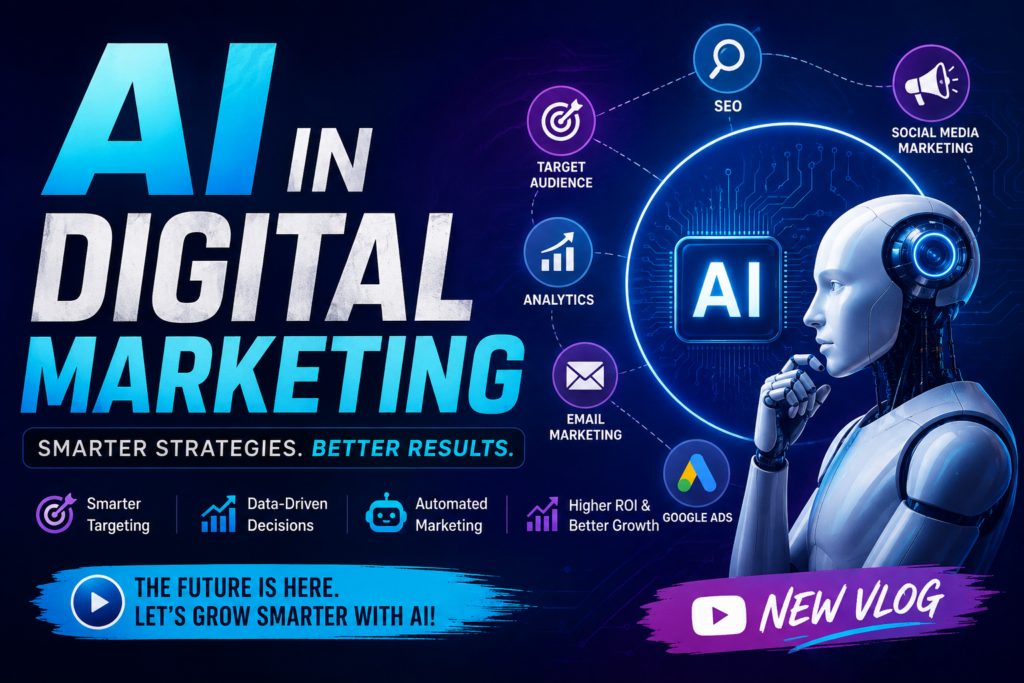
Artificial Intelligence (AI) is changing the way businesses approach digital marketing, making campaigns smarter, faster, and more personalized. In this vlog, we explore how AI is becoming an important part of modern digital marketing and how marketers can use it to improve their strategies. AI can analyze large amounts of customer data, understand user behavior, identify trends, and help businesses make better marketing decisions. From content creation and keyword research to audience targeting and campaign optimization, AI tools can save marketers valuable time and improve efficiency. AI is also transforming search engine optimization by helping marketers identify relevant keywords, understand search intent, and create content that provides better value to users. In social media marketing, AI can help businesses analyze engagement, suggest content ideas, identify the right audience, and determine suitable times to publish posts. In paid advertising, AI can analyze campaign performance and help optimize bids, audiences, and ad placements to improve results. Another major benefit is personalization. AI can help businesses deliver relevant messages, product recommendations, and offers based on customer interests and online behavior. However, AI should not completely replace human creativity and decision-making. Marketers still need strategy, critical thinking, originality, and an understanding of their audience. The most effective approach is to combine AI technology with human expertise. In this vlog, we will look at practical applications of AI in digital marketing, the benefits it offers, the tools marketers can explore, and some challenges they should keep in mind. Whether you are a business owner, student, marketer, or digital marketing professional, understanding AI can help you stay competitive in a rapidly changing industry. AI is not simply a trend; it is becoming a powerful marketing assistant that can help businesses work smarter, understand customers better, and achieve stronger results. As technology continues to evolve, marketers who learn how to use AI responsibly and strategically will be better prepared for the future of digital marketing.
AI in Digital Marketing: How AI Is Transforming Modern Marketing
Introduction
Hello everyone, welcome back to the vlog.
Today, we are going to talk about a topic that is changing the digital marketing industry very quickly — Artificial Intelligence, or AI, in digital marketing.
You may have already seen AI tools that can write content, generate images, analyze data, create advertisements, answer customer questions, and even help with marketing strategies. But AI in digital marketing is much bigger than simply using a tool to generate content.
AI is changing how marketers understand customers, create campaigns, analyze performance, automate repetitive tasks, and make business decisions.
In this vlog, we will understand what AI in digital marketing actually means, how marketers are using it, its major benefits, its limitations, and what the future of digital marketing could look like with AI.
So, let’s get started.
What Is AI in Digital Marketing?
First, let’s understand what Artificial Intelligence actually means.
Artificial Intelligence is technology that allows computers and software to perform tasks that normally require human intelligence. These tasks can include understanding language, recognizing patterns, analyzing information, making predictions, and generating content.
When we combine AI with digital marketing, AI helps marketers use data and technology to make marketing activities more efficient and targeted.
For example, a business may have thousands of customers visiting its website every month. Each customer may have different interests, behaviors, and preferences.
Analyzing all of this information manually can take a lot of time.
AI can process large amounts of data quickly and identify patterns that marketers can use to improve their campaigns.
This is one of the main reasons AI has become so important in digital marketing.
Why Is AI Becoming Important in Digital Marketing?
Digital marketing produces a huge amount of information every day.
Businesses collect data from websites, social media platforms, search engines, advertising campaigns, emails, and customer interactions.
The challenge is not simply collecting this data.
The real challenge is understanding it and turning it into useful decisions.
This is where AI can help.
AI can analyze information, identify patterns, automate repetitive processes, and provide recommendations.
For example, instead of manually analyzing thousands of customer interactions, marketers can use AI-powered systems to identify common customer behaviors.
This allows marketers to spend more time on strategy and creativity instead of repetitive tasks.
AI in Search Engine Optimization
Let’s start with one of the most important areas of digital marketing — SEO, or Search Engine Optimization.
SEO is the process of improving a website and its content so that it can become more visible in search engine results.
Traditionally, SEO professionals spend a lot of time researching keywords, analyzing competitors, understanding search intent, finding content opportunities, and monitoring rankings.
AI can assist with many of these activities.
For example, AI tools can help marketers generate keyword ideas, organize topics, identify related searches, analyze content, and understand what users may be looking for.
Let’s take an example.
Suppose someone searches for:
“Best digital marketing course for beginners.”
A marketer should not only focus on the keyword itself.
They should understand the searcher’s intention.
Is the person looking for course fees?
Are they looking for certification?
Do they want placement assistance?
Are they looking for online or offline training?
AI can help marketers analyze patterns and understand these different possibilities.
However, there is one important thing to remember.
AI should support SEO professionals, not replace them.
Content still needs to be accurate, useful, original, and relevant to the audience.
AI in Content Marketing
The next area is content marketing.
Content is a major part of digital marketing.
Businesses create blog posts, social media posts, videos, advertisements, emails, landing pages, and many other types of content.
Creating content consistently can be time-consuming.
AI can help marketers with brainstorming, research, content outlines, drafts, summaries, and content variations.
For example, imagine you want to create a blog about digital marketing.
Instead of spending hours trying to decide what sections to include, you can use AI to brainstorm possible topics and create an initial structure.
You can then review those ideas, add your own experience, research the information, and create the final content.
This is an important distinction.
AI can help with the process of creating content, but marketers should still provide human expertise and originality.
If everyone simply copies AI-generated content without adding anything useful, the internet can become filled with repetitive information.
Therefore, AI should be used as a creative assistant rather than a complete replacement for human creativity.
AI in Social Media Marketing
Now let’s talk about social media.
Platforms such as Instagram, Facebook, LinkedIn, YouTube, and other social networks generate enormous amounts of data.
Marketers need to understand what type of content their audience likes, what topics generate engagement, which posts perform well, and when their audience is most active.
AI can help analyze this information.
For example, if a business has published hundreds of social media posts, AI can help identify patterns in the performance of those posts.
It may help marketers understand which topics or formats receive more engagement.
AI can also help with:
-
Content ideas
-
Caption creation
-
Audience analysis
-
Sentiment analysis
-
Content planning
-
Performance analysis
-
Trend identification
However, social media is still about human connection.
A completely automated social media account may feel robotic.
Brands need personality, creativity, and genuine communication.
So again, the best approach is to combine AI with human input.
AI in Google Ads and Paid Advertising
Another major application of AI is paid advertising.
Platforms such as Google Ads use machine learning and automation to help advertisers optimize campaigns.
AI can analyze different signals and help with areas such as bidding, audience targeting, campaign optimization, and performance analysis.
For marketers, this can reduce the amount of repetitive manual work involved in managing campaigns.
AI can also help generate advertising ideas and analyze campaign performance.
For example, imagine you have several advertisements running.
Instead of manually checking every data point, AI-powered systems can help identify patterns in clicks, conversions, audiences, and other performance signals.
But marketers still need to understand their campaign objectives.
AI cannot fix a poorly designed marketing strategy automatically.
You still need:
-
Relevant keywords
-
Strong advertisements
-
A good landing page
-
Proper conversion tracking
-
The right audience
-
A clear offer
-
A defined marketing objective
AI can help optimize the campaign, but the foundation still needs to be strong.
AI and Personalized Marketing
One of the most powerful applications of AI is personalization.
Not every customer is interested in the same thing.
Imagine an online shopping website.
One customer may be interested in smartphones.
Another may be looking for headphones.
Another may be interested in laptops.
Instead of showing everyone exactly the same recommendations, AI can analyze customer behavior and help businesses provide more relevant recommendations.
This can create a better customer experience.
Personalization can also be used in email marketing, advertising, websites, and product recommendations.
However, businesses must use customer data responsibly and respect privacy.
Personalization should be useful rather than intrusive.
AI in Email Marketing
Email marketing is another area where AI can assist marketers.
Businesses often have thousands of subscribers.
Sending the same message to everyone may not always be effective.
AI can help marketers analyze customer behavior and create different audience segments.
For example, a business may have:
-
New subscribers
-
Existing customers
-
Previous customers
-
Highly engaged users
-
Customers who have not purchased recently
Each group may require a different type of communication.
AI can help marketers analyze these groups and create more personalized campaigns.
It can also assist with subject-line ideas, content variations, campaign analysis, and automation.
The goal is not to send more emails.
The goal is to send more relevant emails.
AI in Customer Service
Customer service is another area where AI is becoming increasingly common.
Many businesses now use AI-powered chatbots to answer basic customer questions.
For example, customers may ask:
“What are your business hours?”
“How can I track my order?”
“What services do you offer?”
“How can I contact your team?”
AI can answer many simple questions quickly.
This can save time for both customers and businesses.
But there are situations where human support is still necessary.
If a customer has a complicated problem or complaint, they may want to speak with a real person.
Therefore, businesses should use AI to support customer service rather than completely remove human interaction.
AI for Data Analysis
One of the biggest advantages of AI is its ability to process large amounts of data.
Digital marketers have access to numerous metrics.
For example:
-
Website traffic
-
Clicks
-
Impressions
-
Conversion rates
-
Engagement
-
Leads
-
Sales
-
Customer behavior
Looking at all this information manually can be difficult.
AI can help identify patterns and trends.
For example, it may help a marketer discover that one audience segment generates more conversions than another.
The marketer can then use that information to make better campaign decisions.
This is why AI can help move marketing from guesswork toward more data-driven decision-making.
AI for Lead Generation
Lead generation is another important application.
A lead is a potential customer who has shown interest in a business.
AI can help businesses identify and prioritize potential customers based on their behavior.
For example, imagine someone visits a website several times, reads multiple service pages, downloads a brochure, and fills out a contact form.
An AI-powered system may help identify this person as a high-intent lead.
Sales teams can then prioritize these leads.
This can help businesses use their time more efficiently.
Major Benefits of AI in Digital Marketing
Now let’s look at some of the biggest benefits.
1. Saves Time
AI can automate repetitive marketing tasks and help marketers work faster.
2. Analyzes Large Amounts of Data
AI can process huge amounts of information and identify useful patterns.
3. Improves Personalization
AI can help businesses deliver more relevant content and recommendations.
4. Supports Better Decisions
AI can provide data-driven insights that marketers can use when planning campaigns.
5. Improves Productivity
Marketers can spend less time on repetitive tasks and more time on strategy.
6. Helps With Automation
AI can automate different parts of the customer journey and marketing process.
7. Improves Customer Experience
AI can provide faster responses and more relevant information.
These benefits explain why businesses across different industries are exploring AI for marketing.
What Are the Challenges of AI?
AI has many advantages, but it also comes with challenges.
The first challenge is accuracy.
AI can sometimes generate incorrect information.
Therefore, marketers should always review important information before publishing it.
The second challenge is originality.
If marketers depend too heavily on AI, their content may become generic.
The third challenge is privacy.
Businesses need to be responsible when collecting and using customer information.
Another challenge is over-automation.
Marketing is ultimately about people.
If every interaction feels automated, customers may feel disconnected from the brand.
Therefore, businesses need to find the right balance between technology and human interaction.
Will AI Replace Digital Marketers?
This is probably one of the most common questions about AI.
Will AI replace digital marketers?
The simple answer is that AI will automate many tasks, but digital marketing involves much more than performing tasks.
Marketing requires understanding customers, creating strategies, developing brand positioning, understanding emotions, making decisions, and adapting to changing market conditions.
These areas still require human judgment and creativity.
The future is therefore likely to be about marketers working with AI rather than marketers competing against AI.
A marketer who knows how to use AI effectively may be able to work faster and make better use of data.
So instead of asking:
“Will AI replace marketers?”
A better question is:
“How can marketers use AI to become more effective?”
How Beginners Can Start Using AI
If you’re a beginner in digital marketing, you don’t need to learn every AI tool available.
Start small.
Look at your daily marketing activities and identify repetitive tasks.
For example, you might use AI for:
-
Brainstorming content ideas
-
Creating content outlines
-
Keyword research support
-
Ad copy variations
-
Social media ideas
-
Data summaries
-
Customer FAQs
-
Email ideas
-
Campaign analysis
But always review the output.
Think of AI as an assistant.
You provide the objective and direction.
AI helps you with the process.
You make the final decision.
The Future of AI in Digital Marketing
The future of AI in digital marketing is likely to involve even more automation and personalization.
Marketing platforms will continue developing smarter systems for understanding customer behavior, optimizing campaigns, and analyzing data.
AI may help marketers predict customer needs, create more personalized experiences, and optimize campaigns in real time.
But human skills will remain extremely important.
Future marketers will need to understand both technology and people.
They will need to know how to use AI tools, but they will also need creativity, communication, strategic thinking, and business knowledge.
The marketers who learn to combine these skills will be better prepared for the changing industry.
Conclusion
So, let’s quickly summarize what we learned today.
AI is transforming digital marketing.
It is being used in SEO, content marketing, social media, paid advertising, email marketing, customer service, personalization, data analysis, and lead generation.
AI can help marketers save time, analyze data, automate repetitive tasks, and create more personalized customer experiences.
But AI is not a replacement for human creativity and strategy.
The most effective approach is to combine AI technology with human intelligence.
Use AI to work faster.
Use AI to analyze information.
Use AI to generate ideas.
But use your own experience, creativity, and judgment to make the final decisions.
The future of digital marketing is not simply about AI.
It is about how effectively marketers can use AI to create better experiences and better strategies for their audiences.
And that is what makes AI in digital marketing such an important topic to understand today.
That’s all for today’s informative vlog on AI in Digital Marketing.
Thanks for watching, and I’ll see you in the next vlog!