
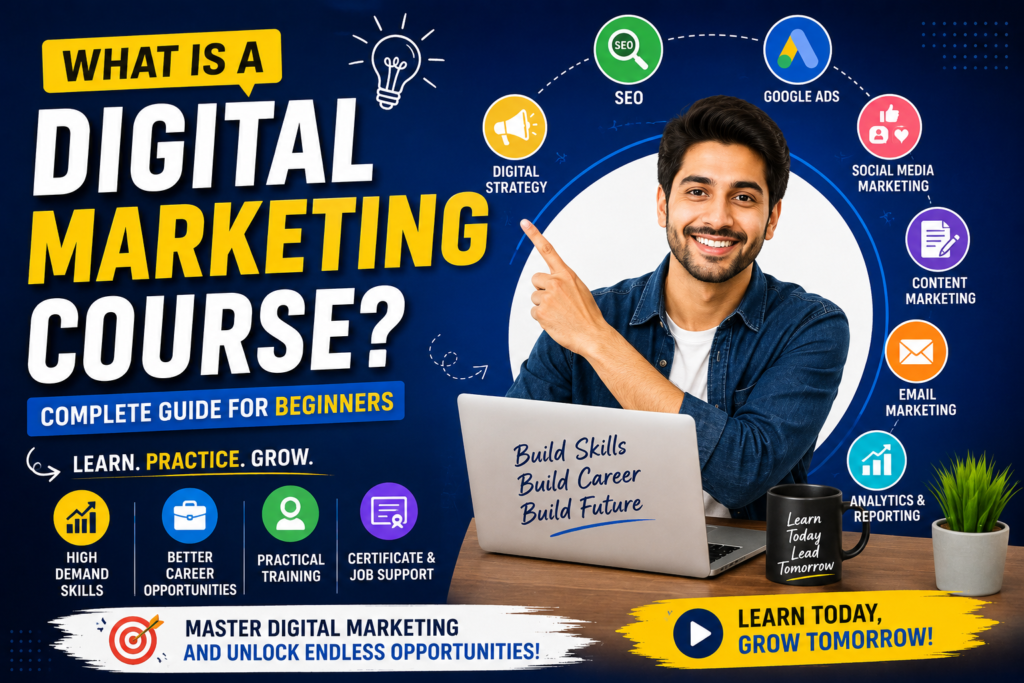
What is a Digital Marketing Course? A digital marketing course teaches you how businesses promote products and services online using SEO, social media, Google Ads, content marketing, email marketing, and analytics. It helps beginners build practical skills for digital marketing careers.
WHAT IS A DIGITAL MARKETING COURSE? | COMPLETE INFORMATIVE GUIDE
Introduction
Hello everyone, welcome back to the vlog!
Today, we are going to talk about a very common question that many students, freshers, business owners, and working professionals have: What is a Digital Marketing Course?
You may have heard people talking about digital marketing, SEO, Google Ads, social media marketing, content marketing, and online advertising. But what exactly do you learn in a digital marketing course? Who should take one? What skills can you develop? And what career opportunities can you explore after completing the course?
In this informative vlog, we are going to answer all of these questions in simple language.
So, let’s get started.
What Is Digital Marketing?
Before understanding a digital marketing course, we first need to understand digital marketing itself.
Digital marketing is the process of promoting a business, product, service, or brand through digital channels.
Today, people spend a large amount of time online. They search for products on search engines, watch videos, use social media, read reviews, visit websites, and communicate through digital platforms.
Businesses use these platforms to reach potential customers.
For example, if you search for “best digital marketing institute near me” on Google and see an advertisement from an institute, that is digital marketing.
If you see a brand promoting its product on Instagram, that is also digital marketing.
If you watch a YouTube video created by a company to educate customers about its product, that is another example.
Digital marketing includes many different areas, and a digital marketing course is designed to teach you how these areas work.
So, What Is a Digital Marketing Course?
A digital marketing course is a structured learning program that teaches students how to plan, create, manage, and measure online marketing campaigns.
The course usually covers multiple areas of digital marketing instead of focusing on only one skill.
Depending on the institute or program, the course may include topics such as:
Search Engine Optimization, or SEO
Google Ads and paid advertising
Social media marketing
Content marketing
Email marketing
Website and landing page basics
Google Analytics and reporting
Lead generation
Performance marketing
Affiliate marketing
Online reputation management
Marketing automation
AI tools for digital marketing
The exact syllabus can be different from one course to another.
Some courses are designed for beginners, while advanced programs may focus more on campaign management, analytics, strategy, and performance marketing.
Why Is Digital Marketing Important?
Digital marketing has become important because customer behavior has changed.
Think about how people make purchasing decisions today.
Before buying a product, many people search online.
They compare prices.
They read reviews.
They watch videos.
They visit websites.
They check social media.
They may even ask questions on online communities.
Because customers are spending more time online, businesses need to be visible where their audiences are.
Digital marketing helps businesses reach potential customers through these online channels.
For this reason, there is growing interest in digital marketing as a professional skill.
A digital marketing course helps learners understand how these channels work and how businesses can use them strategically.
What Do You Learn in a Digital Marketing Course?
Now let’s look at some of the major subjects that are commonly taught.
1. Search Engine Optimization
SEO stands for Search Engine Optimization.
It is the process of improving a website and its content to increase its visibility in search engine results.
For example, imagine you own a digital marketing institute.
You may want your website to appear when someone searches for “digital marketing course.”
An SEO professional works on different aspects of the website to improve its search visibility.
In a digital marketing course, students may learn about:
Keyword research
On-page SEO
Technical SEO
Off-page SEO
Content optimization
Internal linking
Competitor analysis
Search intent
SEO reporting
SEO is an important skill because businesses want to attract people who are actively searching for their products or services.
2. Google Ads and Paid Advertising
Another important part of digital marketing is paid advertising.
Google Ads allows businesses to advertise on Google’s platforms and reach people based on searches, audiences, interests, and other signals.
A digital marketing course may teach students how to create and manage different types of campaigns.
Students can learn about:
Keyword research
Campaign structure
Ad groups
Ad copy
Bidding
Audience targeting
Conversion tracking
Landing pages
Campaign optimization
Performance analysis
For example, if someone searches for “best digital marketing course,” a business may want its advertisement to appear for that search.
Learning how to create relevant and effective campaigns is an important digital marketing skill.
3. Social Media Marketing
Social media marketing focuses on using platforms such as Instagram, Facebook, LinkedIn, YouTube, and other social networks to build awareness, engagement, and business results.
A digital marketing course may teach students how to:
Create social media strategies
Research target audiences
Plan content
Create social media campaigns
Analyze engagement
Run paid social media advertisements
Measure performance
For example, a clothing brand may use Instagram to showcase products and communicate with customers.
A B2B company may use LinkedIn to reach business professionals.
The strategy depends on the audience and business objective.
4. Content Marketing
Content is one of the foundations of digital marketing.
Content can include blogs, videos, social media posts, infographics, emails, guides, and more.
Content marketing focuses on creating useful and relevant information that attracts and engages a target audience.
In a digital marketing course, students may learn how to:
Research content topics
Create content strategies
Write blogs
Develop content calendars
Create social media content
Optimize content for search engines
Measure content performance
Good content should not simply promote a business.
It should provide value to the audience.
5. Email Marketing
Email marketing is another important digital marketing channel.
Businesses use email to communicate with existing and potential customers.
For example, an online store may send emails about new products, special offers, abandoned carts, or order updates.
Students may learn about:
Email campaign creation
Audience segmentation
Email automation
Subject lines
Email copywriting
Campaign tracking
Conversion optimization
Email marketing can be especially useful for maintaining relationships with existing customers.
6. Website and Landing Pages
A website is often the central point of a company’s online presence.
Digital marketing campaigns frequently send visitors to a website or landing page.
Therefore, digital marketers should understand basic website principles.
A course may introduce students to topics such as:
Website structure
Landing pages
User experience
Calls to action
Conversion optimization
Mobile-friendly design
Basic website analytics
The goal is to understand how a website supports marketing campaigns.
7. Analytics and Reporting
Digital marketing is not only about running campaigns.
You also need to understand whether those campaigns are working.
Analytics helps marketers measure performance.
Important metrics can include:
Website traffic
Clicks
Impressions
Click-through rate
Conversion rate
Cost per click
Cost per lead
Return on advertising spend
Engagement
Leads
Sales
A digital marketing course may teach students how to use analytics and reporting tools to understand campaign performance.
This helps marketers make decisions based on data rather than assumptions.
8. Lead Generation
Lead generation means attracting potential customers who show interest in a business.
For example, someone may fill out a contact form, request a consultation, download a guide, or call a business.
Digital marketers use different channels to generate leads.
These can include:
SEO
Google Ads
Social media
Landing pages
Email marketing
Content marketing
Lead generation is particularly important for service-based businesses.
9. Performance Marketing
Performance marketing focuses heavily on measurable business outcomes.
Instead of looking only at impressions or clicks, marketers may focus on results such as leads, sales, applications, or purchases.
Students may learn how to analyze campaign performance and improve results based on data.
This makes performance marketing an important skill for people who want to work with paid advertising and measurable marketing campaigns.
10. AI in Digital Marketing
Artificial Intelligence is becoming an important part of modern marketing.
AI tools can help marketers with research, content ideas, data analysis, automation, customer support, and campaign optimization.
A modern digital marketing course may introduce students to AI tools and explain how they can be used responsibly.
However, learning AI should not mean depending on it completely.
Marketers still need creativity, strategy, communication skills, and human judgment.
Who Should Take a Digital Marketing Course?
One of the biggest advantages of digital marketing is that it can be useful for people from different backgrounds.
Students can learn digital marketing to develop career-ready skills.
Fresh graduates can use it to explore entry-level marketing roles.
Working professionals can learn digital marketing to add another skill to their existing experience.
Business owners can learn the basics to better understand their online marketing activities.
Freelancers can learn digital marketing to offer services to clients.
Even traditional marketers can learn digital marketing to expand their skill set.
You do not necessarily need a technical background to start learning digital marketing.
Basic computer knowledge, communication skills, curiosity, and a willingness to learn are often enough to begin.
Is a Digital Marketing Course Useful for Beginners?
Yes, a properly structured course can be useful for beginners because it provides a systematic way to learn different marketing concepts.
Instead of learning random topics from different sources, a course can provide a structured syllabus.
However, not every course offers the same learning experience.
Before choosing a course, students should look at factors such as:
Course syllabus
Practical training
Projects
Trainer experience
Tools covered
Assessment methods
Industry relevance
Placement support, if offered
Internship opportunities
Course duration
Learning format
The important thing is to look beyond the certificate.
Practical knowledge and the ability to actually use digital marketing tools are more valuable than simply having a certificate.
Why Practical Training Matters
Digital marketing is a practical field.
You can read about Google Ads, SEO, or social media marketing, but applying that knowledge is a different experience.
For example, you may understand what keywords are in theory.
But performing keyword research for an actual business can teach you much more.
Similarly, creating an advertisement in theory is different from launching and optimizing an actual campaign.
This is why practical projects can be an important part of digital marketing education.
Students can learn how to apply concepts instead of only memorizing definitions.
What Career Opportunities Are Available?
After learning digital marketing, students can explore different roles depending on their interests and skills.
Some possible roles include:
Digital Marketing Executive
SEO Executive
SEO Specialist
Social Media Executive
Social Media Manager
Google Ads Specialist
PPC Executive
Performance Marketing Executive
Content Marketing Executive
Email Marketing Executive
Digital Marketing Analyst
Digital Marketing Manager
The exact job title and responsibilities can vary from company to company.
Some people also choose freelancing or start their own digital marketing services.
What Skills Should a Digital Marketer Develop?
A good digital marketer needs more than technical knowledge.
Some important skills include:
Communication
Creativity
Analytical thinking
Problem-solving
Research
Copywriting
Data interpretation
Time management
Adaptability
Strategic thinking
Digital marketing platforms and tools continue to change.
Therefore, continuous learning is important.
What Tools Can You Learn?
Digital marketing involves many different tools.
Depending on the course, students may work with tools related to:
SEO
Google Ads
Analytics
Social media management
Email marketing
Content creation
Keyword research
Graphic design
AI
Reporting
The specific tools can change over time as platforms introduce new features.
Therefore, it is useful to understand the concepts behind the tools instead of learning only how to click through a particular interface.
How Long Does a Digital Marketing Course Take?
The duration of a digital marketing course can vary significantly.
Short introductory courses may take a few weeks.
More comprehensive programs can take several months.
The right duration depends on the depth of the syllabus, practical training, projects, and learning format.
A longer course is not automatically better.
The quality of the curriculum and practical learning experience are more important than the number of months.
Online vs Offline Digital Marketing Courses
Students can learn digital marketing through both online and offline programs.
Online courses can provide flexibility and allow students to learn from different locations.
Offline courses may provide direct interaction with trainers and other students.
Both formats can work.
The better option depends on your learning style, schedule, budget, and preferred method of interaction.
What Should You Look for Before Choosing a Course?
Before enrolling, do some research.
First, check the syllabus.
Make sure it covers the areas you actually want to learn.
Second, look for practical training.
Ask whether students work on real or simulated projects.
Third, check who is teaching the course.
Trainer experience can make a significant difference.
Fourth, understand what tools and platforms are included.
Finally, check whether the course is updated regularly.
Digital marketing changes quickly, so an outdated syllabus can limit your learning.
Certificate vs Skills
Many students ask whether certification is important.
A certificate can demonstrate that you completed a course.
However, employers and clients often want to know what you can actually do.
For example, being able to perform keyword research, create an advertising campaign, analyze results, or develop a social media strategy can be more valuable than simply showing a certificate.
Therefore, focus on developing practical skills.
Build projects.
Create sample campaigns.
Work on your own website or social media page.
Analyze real businesses.
Create a portfolio.
These activities can help demonstrate your capabilities.
Common Misconceptions About Digital Marketing Courses
There are several misconceptions about digital marketing.
One common belief is that you need to be an expert in technology.
You don’t.
Digital marketing does involve technology, but many concepts can be learned without advanced technical knowledge.
Another misconception is that completing a course automatically guarantees a job.
A course can provide knowledge and skills, but career growth also depends on practical experience, communication, portfolio development, interview performance, and continuous learning.
Another misconception is that digital marketing is easy because many tools are automated.
In reality, understanding strategy and interpreting results can require significant learning and practice.
Final Thoughts
So, what exactly is a digital marketing course?
In simple terms, it is a structured program designed to teach you how businesses use digital platforms to attract, engage, convert, and retain customers.
You can learn areas such as SEO, Google Ads, social media marketing, content marketing, email marketing, analytics, lead generation, performance marketing, and AI-powered marketing.
For students and beginners, a good course can provide a structured starting point.
For professionals, it can help expand their existing skill set.
For business owners, it can provide a better understanding of how online marketing works.
But remember one important thing.
A digital marketing course is only the beginning.
The real learning comes from practice.
Digital marketing is constantly changing, so successful marketers continue learning, testing, analyzing, and improving.
If you are thinking about starting a digital marketing course, don’t choose one only because of a certificate or attractive promises.
Look at the syllabus.
Check the practical training.
Understand what tools you will learn.
Research the trainers.
Look for projects and opportunities to apply your knowledge.
And most importantly, choose a learning path that matches your career goals.
Conclusion
Digital marketing has become an important part of the modern business environment, and learning digital marketing can help you understand how businesses reach customers online.
Whether your goal is to work in SEO, social media, Google Ads, content marketing, performance marketing, analytics, or another area, learning the fundamentals can provide a strong foundation.
The industry will continue to evolve with new platforms, technologies, and AI tools.
That means learning digital marketing is not a one-time process.
It is an ongoing journey.
So, if you are interested in digital marketing, start with the fundamentals, practice what you learn, work on real projects, build your portfolio, and continue developing your skills.
That’s the real value of a digital marketing course.
Outro
That’s all for today’s informative vlog on “What Is a Digital Marketing Course?”
I hope this video helped you understand what a digital marketing course is, what you can learn from it, who can take it, and what opportunities you can explore after developing these skills.
If you found this vlog informative, don’t forget to like, share, and subscribe for more content about digital marketing, SEO, Google Ads, social media marketing, AI, and digital marketing careers.
Thanks for watching, and I’ll see you in the next vlog!